Marana Rotary Club Minutes for September 9, 2025
Attendees
Cindy Dooling
John Dooling
Harold Burtzloff
Mark Goligoski
Greg Hansen
Josh Bayne
Peter Mack
Don Jorgensen
Kathy Jorgensen
Mike Ottman
Jean Fedigan, Founder of Sister Jose Women’s Center, Speaker
Becky Penman (via Zoom)
Andrea de la Cruz (via Zoom)
Bob Bishop (via Zoom)
Maria Altamirano (Quick), recipient of TRVFA award (via Zoom)
Introductions
President Cindy Dooling called the meeting to order at 7 am. After the Pledge of Allegiance, attendees took some time to introduce themselves including those attending via Zoom.
Maria Altamirano (Quick), recipient of TRVFA award
At 7:15 am Maria Altamirano (Quick), recipient of an award from Rotary Vocational Fund of Arizona (TRVFA) gave us background on her history and professional progress. Maria received a college degree in Liberal Arts, then about a decade later decided to pursue a degree in Dental Hygiene from Pima Community College to achieve better work-life balance.
Some of the obstacles she faced in obtaining her Dental Hygiene degree were the 3-year wait list to get into the program, making up her deficit in science-related courses, her program started in the middle of covid, and being pregnant and the demands of caring for an infant during her program. The Rotary Vocational Scholarship eased the financial burden of her education and training.
She has obtained further training in Dental Therapy, allowing her to provide many of the more routine services of a dentist expanding access to affordable oral healthcare, especially for underserved communities.
Jean Fedigan, founder of Sister Jose Women’s Center
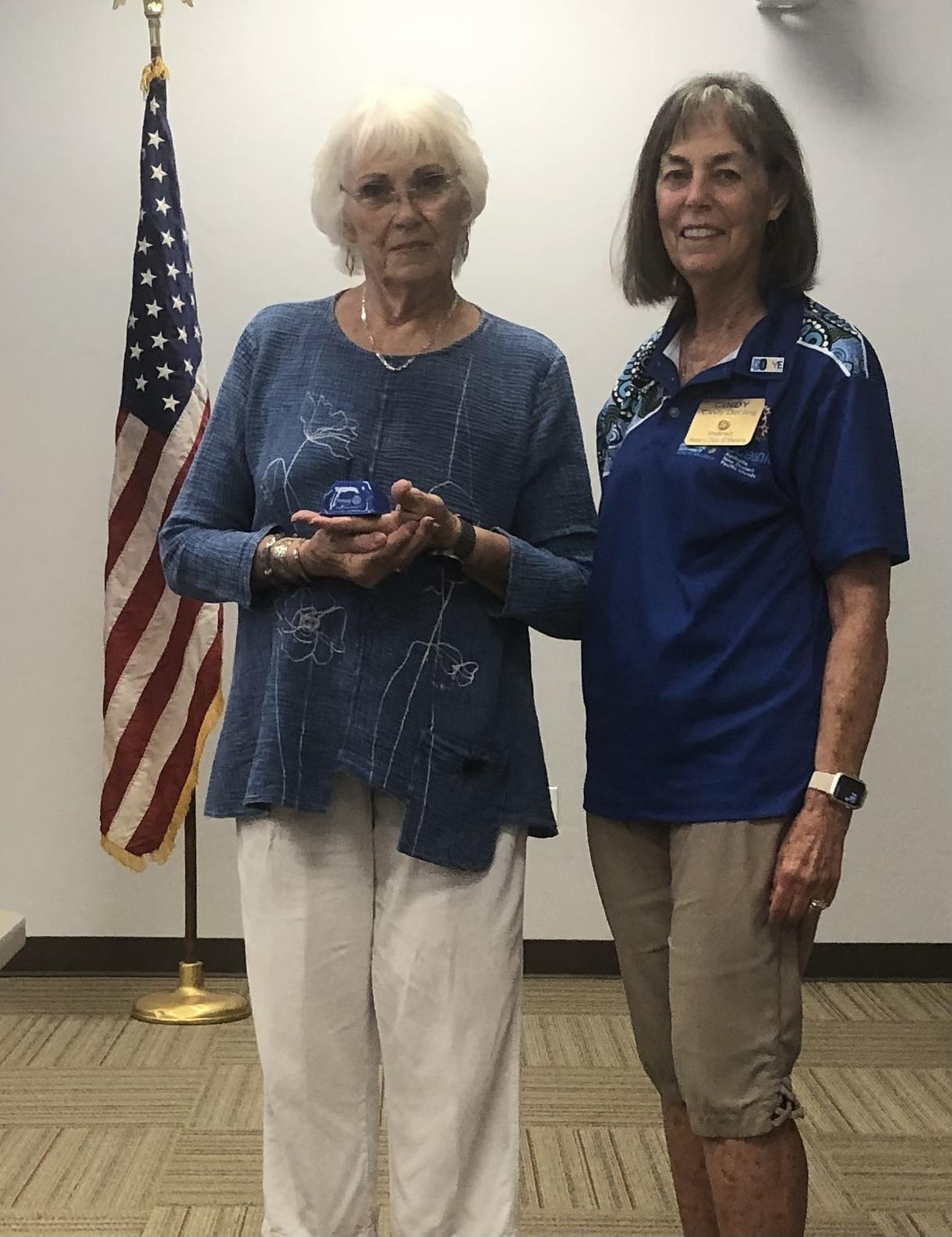 At 7:30 am, Jean Fedigan, founder of Sister Jose’s Women’s Center, started her presentation. Jean has a BS in Nursing and MBA in Healthcare Management. She has been a registered nurse since 1993 and has held various leadership positions since 2005 at the University Physicians Network in Tucson including Chief Nursing Officer. In 2009, Jean was instrumental in opening an emergency housing program for women in Tucson, and in 2012 this program became a non-profit corporation named after Sister Jose Hobday, a Franciscan nun who was a mentor to Jean.
Jean set up the Sister Jose Women’s Center since the needs for homeless women were not being met. We get up in the morning thinking what we are going to have for breakfast, homeless women wake up thinking how they are going to survive the day. Roughly 70% of the women on the streets are mentally ill, and if they were not mentally ill originally, there is a good chance they will eventually become mentally ill due to the trauma they experience on the streets. Sister Jose’s provides mental health support to their clients.
Sister Jose Women’s Center is the only center in town that allows animals. Homeless women have animals for safety and will often feed their pets before themselves since their survival depends on their pets who provide protection. Females on the street will be robbed, and the animals can alert these women of approaching strangers especially when they are sleeping. Men will often offer to provide homeless women with “protection” but after about a week they will usually ask for repayment in the form of sexual services for themselves and their friends. These men will also provide the women with drugs to help them cope with continued sexual abuse. The sexual exploitation of women on the streets is a form of human trafficking. Women are reluctant to report her rapists to the authorities for fear of lethal retribution.
Homeless women will often have all their belongings stolen including all their money, identification card, social security card, and birth certificate. Sister Jose Women’s Center works with these women to help re-establish their ID.
Women in three groups are especially vulnerable to becoming homeless. The first are children who age out of the foster system, the second is women with children who have abusive partners, and the third is older women. Individuals who age out of the foster system often do not have a stable income or friends or family members who can take them in. After a domestic violence call, police will sometimes remove a female and her children and deliver them to Sister Jose Women’s Center. About a third of overnight guests at Sister Jose Women’s Center are over 55. Older women can become homeless when their husbands die and her social security payment alone no longer covers rent.
Finding housing for homeless women is problematic. The average price to rent an apartment in Tucson is about $1000/mo, and most apartment complexes ask for first and last month’s rent up front, so $2000 is needed initially. Low income housing is often not a great alternative since many of the residents use drugs, and women in these situations often come back to the Center. Jean Fedigan is working with Arizona State University on a project to determine what causes the high rate of recidivism for homeless women provided housing.
The women served by could be our mother, daughter, sister, grandmother, aunt, friend, or anyone else just like us. The Center relies heavily on male and female volunteers and there are many ways to help.
Sister Jose Women’s Center is located at Park and 21st. The Center does not ask for an ID or require a breathalyzer test; they accept the women as they are who are among the lowest of the low.
The Center welcomes visitors who will be given a tour of the facility. Most people are astounded by the grace of these homeless women. Contact Jean Fedigan directly on her cell phone (520-954-3373) to arrange a tour of the facility.
Conclusion
At 8 am the meeting adjourned after recitation of the Four-Way Test.